


The Cuban Missile Crisis offers the best lens available through which we can examine the possibilities of nuclear confrontation, problems of crisis management and opportunities for crisis prevention and many more. This is the only time in the postwar era when the United States and the Soviet Union contemplate actions that could have led directly to nuclear war. At the time, President Kennedy estimated the risks of war as “between 1 in 3” and even Chairman Khrushchev remarked “ the smell of burning was in the air.” Whatever the actual risks, it is agreed that on no other postwar occasion did the superpowers stand so close to the nuclear brinksmanship.
Our understanding of this crucial event thus continues to shape the lessons that should be learned from that critical historical event. Lets assess the impact of the Cuban Missile Crisis now

1. Change in Reputation of Presidents of the Superpower Nations, Khrushchev and Kennedy
Khrushchev lost prestige. In the eyes of the Soviets, he had failed. Soviets were forced to remove missiles from Cuba while USA were seen not required to do anything in return. The removal of US missiles in Turkey was a secret operation. Kennedy gained prestige. He was seen as the men who faced down the Russians.
2. MAD (Mutual Assured Destruction) was put into operational use and proven to be very effective
 MAD is parallel to a military strategy based on the theory of deterrence, where full scale use of nuclear weapons would result in destruction of both parties involve in the war. It effectively dissuades one party to proceed with deployment of powerful arms in view of possible retaliation by the enemy with the same mode of attack. It results in Nash Equilibrium, were both parties try to prevent the worst possible outcome.
3. Cuba was the start of the end of the Cold War. After the Cuban Missile Crisis, talks and negotiations took place.There were more opened dialogues and many treaties were thereafter signed and ratified by USSR and USA. The 1,113 prisoners captured during theBay of Pigs invasion were exchanged by Castro for $60 million in food, drugs, medicine and cash.
4. Anti Nuclear Testing - Nuclear Test Ban Treaty 1963.
This treaty bans Nuclear Weapon Tests in the Atmosphere,Outer Space and Underwater. This treaty serves to prohibit all test, intention or indication, of nuclear weapons except underground. It aims to decelerate arms race and stop unnecessary use of nuclear warheads. It was first ratified by Governments of USSR, UK and USA. The treaty went into effect on October 10, 1963. It is still standing today.
5. Hot Line Treaty of 1963, Direct Communication established

This is a Moscow-Washington hotline system that allows direct communication between presidents of the United States and Russia. It was established on 20 June 1963 subsequent to the signing of the "Memorandum of Understanding Regarding the Establishment of a Direct Communications Line" in Geneva, Switzerland, by representatives of the Soviet Union and the United States.

The Cuban Missile Crisis highlighted the importance of a clear and direct system of communication between USA and USSR. It was hoped that a hotline would help prevent dangerous confrontations such as the Cuban Missile Crisis arising again. As such, this system was set up and it is still standing today.
6. Agreement of Equivalence Military prowess of United States and Soviet Union

By the end of the 1960s, the Americans had achieved strategic parity with the Soviets. In overall military capability, the United States could no longer be considered paramount. Thus, USSR has the authority to command negotiations with USA with issues pertaining arms control.There were collaborative efforts by both nations for arms control and this resulted in the signing of many bilateral agreements.
7. Subsequent outburst of Nuclear Wars - Prevented or Possible?
 At the recent 40th anniversary conference on the Cuban Missile Crisis, it was noted that "the lessons learned from the missile crisis might assist those of us who are interested in reducing the risk of nuclear catastrophe in the 21st century".
The Cuban Missile Crisis showed the whole world about the eminent and inevitable dangers of having a full scaled nuclear war. This has shaken the whole world and propelled nations to reconsider alternatives before engaging into such wars.Therefore is subsequent outburst of Nuclear war prevented?
The Cuban Missile Crisis showed that Nuclear war was indeed possible. Forty-two years after World War II, having enjoyed four decades without nuclear war or any general war, majority of the global citizens had the premature mindset that war has become obsolete and that World Peace is the norm. The further we get from those fateful 13 days, the more unlikely it becomes that this conflict could have led to nuclear war. Given the consequences of such a war, the stakeholders involved simply does not justify such an outcome.
No event demonstrates more clearly the fateful gap between “Implausibility” and “impossibility” than the Cuban Missile Crisis. Therefore is subsequent outburst of Nuclear war possible? This is a question that still challenges us today. One of the impacts of the Cuban Missile Crisis is that it led to such speculation.

8. Importance of Peaceful Co-exsistence-Impact on
Foreign Policy & the Reality of Nuclear Interdependence
The Cuban Missile Crisis demonstrated to the superpowers the significance of co-existing peacefully. It began the period of 'dètente' and thaw of cold war. This period started with the introduction of a telephone hotline between the USA and USSR and a series of treaties, including the Anti-Ballistic Missile (ABM) Treaty, and the two Strategic Arms Limitation Talks (SALT I and II). The foreign policies of superpower nations were inclined to promoting peaceful co-exisence.Technology has created for the United States and Soviet Union an inescapable common interest in avoiding the major nuclear war of which they would be the first victims. Who depends on whom and how much? USA has the power to destroy USSR with nuclear warheads. But USA faces the same threat from USSR. There is thus one indisputable implication: USA's security is dependent upon USSR's security and vice versa. This is a concept of “mutual security” that precedes 'national security'.
9. The Cuban Misile- Impact on International Law

The Cuban Missile Crisis has influenced international law. In October 2002, a conference hosted by Fidel Castro was held in Havana. It was a rare event because participants from the United States, Soviet, and Cuban governments attended the gathering, sharing their impressions of what had happened during the crisis. After the Cuban Missile Crisis, there was a question of justification of intervention of international bodies in wars between superpowers that had potential to affect the whole world. This is thus address in article 51 of the United Nations'Charter. It provides for the right of countries to engage in military action in self-defence, including collective self-defence (i.e. under an alliance).
Article 51 states: Nothing in the present Charter shall impair the inherent right of individual or collective self-defence if an armed attack occurs against a Member of the United Nations, until the Security Council has taken measures necessary to maintain international peace and security. Measures taken by Members in the exercise of this right of self- defence shall be immediately reported to the Security Council and shall not in any way affect the authority and responsibility of the Security Council under the present Charter to take at any time such action as it deems necessary in order to maintain or restore international peace and security.
10. The perils of crisis management

The Cuban Missile Crisis has influenced the management of international crises. The perils of crisis management are vital in times where the uncontrollable and undesirable may happen. Any one action by the USA or USSR may triggered a chain of reactions ending in war. Crisis must be prevented. The Cuban Missile Crisis offers good tips on how to prevent or to provoke crises.
Firstly, limit misunderstandings of real interests and real intention. The Kennedy administration failed to communicate clearly its commitment not to allow Cuba to become a base for offensive Soviet threats to United States. They did not put it across clearly that USA had no intention of rising and American military invasion of Cuba.
Secondly, is the importance of the unwritten rules of the game that constrain the US- Soviet competition. Kennedy was shocked by Khrushchev’s lack of appreciation of what he referred to at the time as the “rules of the precarious status quo". Installing missiles in Cuba clearly violated these rules. If the Soviet leader could understand the United States' interests, so Kennedy reasoned, he is willing to do anything to re- establish and understanding of these constraints on which the peace depended. Since the missile crisis, both American and Soviet leaders have come to understand better these unwritten rules. Also there were discussions between the United States and the Soviet Union about areas of potential dispute hold promise of much greater appreciation of these rules and their applications. This leads to better appreciation of the relative importance of parallel interests vs. competing interests in the US-Soviet relationship.
Given the inescapable threat both face together, each must reconsider its interests in situations that allow independent initiatives by third parties to engage superpower interests. Regional discussions that distinguish between real primary interests and secondary interests offer promise on this front. 11. Diplomatic Relationship between China and Soviet Union was on the Decline
12. United States on the advance
After the Cuban Missile Crisis, the United States became convinced that the Soviet Union would not go to war over another communist country. This indirectly encouraged the United States to help attempts to overthrow socialist and communist governments in Vietnam, Nicaragua and Grenada.
Initially, the EXCOM agreed that full military invasion was the best solution. However, President Kennedy objected to taking such an action, he countered that although Soviet Union could not do anything to United States, they could use the invasion as an excuse to take over United States’ zone of occupation in Germany.
After another U-2 flight on the night of the 17th, the military discovered intermediate range (IRBMs)SS-5 nuclear missiles. With the exception of Washington and Oregon, these missiles could reach all of the continental U.S.
By October 19, the missile bases in Cuba were showing signs of operating, the EXCOM had to do something. In the end, they came to a conclusion. The best way out was to set up a naval blockade to prevent missiles warhead from Soviet Union from reaching Cuba, so that there could be no attack on the United States and at the same time United States are not initiating a war.
The Quarantine
October 21-24, 1962
United States sent ships to surround Cuba, forming a physical barrier around it so ships carrying warheads from Soviet Union will not be able to reach it. On October 22, Kennedy made an announcement to the United States and to the world, he revealed his decision and emphasized that what is his doing is quarantine and not blockade, he would use the word "quarantine" instead of "blockade." This suggestion, made by George Ball, Under Secretary of State, was an important one. A blockade, as defined under international treaties is an act of war. A quarantine, on the other hand, is merely an attempt to keep something unwanted out of a particular area. In sum, the U.S. could have its blockade but the international community would not consider it an act of war.
Upon hearing this news, Soviet leader, Nikita Khrushchev was infuriated. He believed that no matter what they named it, the United States action was an act of war and should be stopped. Yet no action was made to stopped the United States.
On October 24, Soviet ships reached the quarantine line but they received orders from Moscow to halt and wait for further orders. Although they halted, United States was not at all relief because these ships were tailed by Soviet submarine.
Towards the end of Crisis
October 25-28, 1962
Finally, on October 26, President Kennedy received a letter from Soviet leader Krushchev asking for peace. In his letter, Khrushchev mentioned that Soviet will remove all their missiles from Cuba if United States promised not to invade Cuba. While one U-2 spy plane accidentally flies into Russia, another is shot down over Cuba. EX-COMM receives a second letter from Khrushchev stating that, in addition to a public promise not to invade Cuba, the U.S. removed its missiles from Turkey. Eventually, President Kennedy agreed to do what Khrushchev wanted on the condition that the second term a secret.
October 28, President Kennedy and Khrushchev came to an agreement, missile bases in Cuba were removed and the ships that were stationed at the quarantine line headed back to Soviet. The Crisis had come to an end.
By: Shen Yichen
Introduction
In October 1962, the USA came to a sudden realisation that the Soviet had installed a number of medium ranged missiles on Cuba. Furthermore, they found out that the Soviets were in the process of sending intermediate ranged nuclear missiles to Cuba, which could target almost any major city in the US. The crisis was gone as quickly as it came. The doomsday clock which showed how close we are to nuclear doomsday didn’t even move as the crisis was only 13 days. The causes of the crisis however, had deep roots in the history of the USA, USSR and Cuba. These are actually referring to the long term causes. What most people who knew about the crisis would give as the cause would be the immediate term causes, or rather the triggers. Let’s talk about these first.
Triggers and Immediate Causes
The first thing most would say to be the cause of the crisis would be Khrushchev sending missiles to Cuba. This is true, for the whole crisis was about these missiles, and how they would threaten world peace. What is really interesting is why, and we’ll discuss this later.
Though the missiles were the focus of the crisis, the actual trigger was the U2 spy photos that revealed these missiles and America’s reaction to it. The thirteen days of crisis only started after the missiles were revealed. The Americans had actually declared a crisis and took actions both militarily and diplomatically. This greatly heightened tension and actually brought forward the crisis itself. It is also worth to note the fact the both sides had refused to back down during the crisis, adding to the tension.
The Long Term Causes
Studying only the triggers would not have helped much if we really wanted to understand the entire crisis. Questions relating to this section would probably be something like “Why had Khrushchev decided to send missiles to Cuba?” The fact is that the crisis is a result of many years of mistrust and conflict between the superpowers. Conflicts in Cuba also had a major role to play.
Thus the causes can be split into 3 major sections:

| October 1962 | ||||||
|---|---|---|---|---|---|---|
| Monday | Tuesday | Wednesday | Thursday | Friday | Saturday | Sunday |
| 1 | 2 | 3 | 4 | 5 | 6 Jet Fighters sent to Florida | 7 |
| 8 | 9 Kennedy starts U2 flights | 10 US Senator Kenneth Keating claims Soviets have missile pads in Cuba | 11 | 12 | 13 | 14 U2 finds missiles sites in Cuba |
| 15 Photos are analyzed and missiles are found. Sites nearing completion | 16 Kennedy is informed and sets up Ex-Comm | 17 Options are discussed | 18 Kennedy meets with Soviet Minister Gromyko. More missile sites found | 19 Kennedy returns from Chicago and is informed about options | 20 | 21 Allied Nations are informed and Kennedy decided on quarantine |
| 22 Kennedy address the USA and the world | 23 Soviet Ships and submarines approach | 24 Soviet ships are stopped and a U2 shot down over Cuba | 25 2 oil tankers are allowed through the quarantine and USA shows evidence of missiles during UN meeting | 26 Khrushchev sends message to Kennedy | 27 Khrushchev sends second letter, Americans agree to conditions | 28 Soviets agree to dismantle missiles, crisis is over |
| 29 | 30 | 31 | ||||
 JFK - John Fitzgerald Kennedy, President of the United States, Cuban Missile Crisis
 Nikita Sergeyevich Khrushchev, Premier of the Soviet Union, Cuban Missile Crisis
 Fidel Alejandro Castro Ruz, President of Cuba, Cuban Missile Crisis
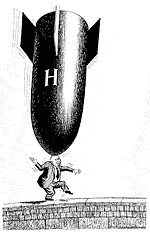 http://cairsweb.llgc.org.uk/images/ilw1/ilw3555_t.gif
The cartoon shows Khrushchev balancing the nuclear missile on his head while walking on a wall. It shows just how unstable the situation was at that time. The cartoon suggested that Khrushchev started the crisis.
Websites
GCSE Modern World History
Wikipedia
Time Magazine Archives
Nov 02, 1962
Nation: The Showdown
Nation: THEIR BASES & OURS
Foreign Relations: The Backdown
World: The East's Reply
World: The West's Response
United Nations: Until Hell Freezes Over
A Letter From The Publisher: Nov. 2, 1962
(Cold War: After Cuba)
Nov 09, 1962
Russia: The Adventurer
Foreign Relations: The Morning After
Nation: U.S. BASES ABROAD
(Nation: The First Casualty)
Videos
General overview(Flash)

